
- Abstract
- Introduction
- Prelimianries
- Definition
- Community
- Theory
- Results
- Conclusion
- Appendices
 . Download PPT (16MB)
A PLACE OF UNDERSTANDING
ABSTRACT
Place of Understanding [Place] avoids the philosophically controversial matter of existence, and concerns itself with whether something is present or absent in a given setting. Place determines that a theory should start with a blank context, introduce meanings from natural language via axiom, enforce some needed restrictions on initial, elementary meanings, and comply with its common-sense rules for definition, construction and communication..
-
 From a Source
 to
to Defined Thing
 Definitions
Place of Understanding requires that a definition provide a clear separation between: a) the-defined-thing and b) what is NOT the-defined-thing
-


Construction
A construction site or workspace provides the context for building things. Defined raw materials are needed as inputs to the construction process.
-
From: Meaning
Wall
To: Name/Symbol
Communication
Communication requires standards.
-
Meanings from Natural Langague
 Defined Thing
 Theories
We communicate about science via theories. Each theory requires a well-defined mental workspace.
A Place of understanding
Introduction
Truth. How do you know whether what you believe is true or not? Or, how do we know whether what society accepts as knowledge is true or not?
In the past, it was “known” that “the earth is flat.” This key fact was critical to the scientific understanding of how the world and universe worked. Now, we know that this fact is false. Furthermore, history has had more than one knowledge revolution as Thomas Kuhn shows in his work The Structure of Scientific Revolutions. Each revolution has led to the demise of cherished facts.
Through Kuhn’s work, we have become aware that people working onknowledge accept many assumptions that make up a paradigm. Given society’s track record, we admit the possibility that the current paradigm could change. Consequently, today’s scientist lives with the threat that his or her research could be negated if the reigning paradigm is overturned.
The following treatise presents the opportunity to rectify this situation so that what we know as a society continues to be true indefinitely.
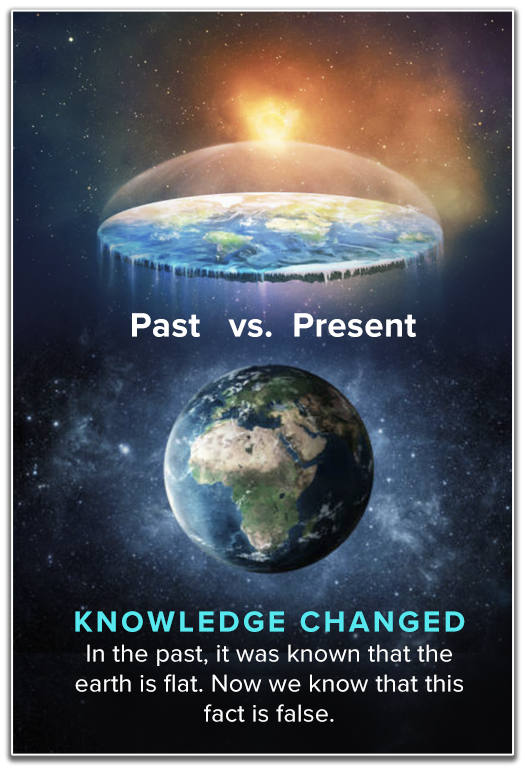
How is this Posible
All knowledge rests on assumptions. If fundamental assumptions that have long-term integrity and avoid incorrect biases could be identified and accepted by the community of scholars, then we could secure a reliable paradigm and foundation.
The following body of work proposes this kind of axiomatic assumptions.
If ideal assumptions are proposed, however, would everyone agree to accept them as the standard group of assumptions? The history of knowledge development includes controversy over definitions, territory disputes, ad hoc theories, and destructive politics. If agreement on standards could be sustained, then productivity, accuracy, and reliability could be greatly increased.
The following pages set forth assumptions, definitions, rules, and methods that are proposed as standards for the work we do together on knowledge. These standards provide a universal frame of reference that is a reliable basis for explanations about how the world works. This foundation supplies the keys to truth.
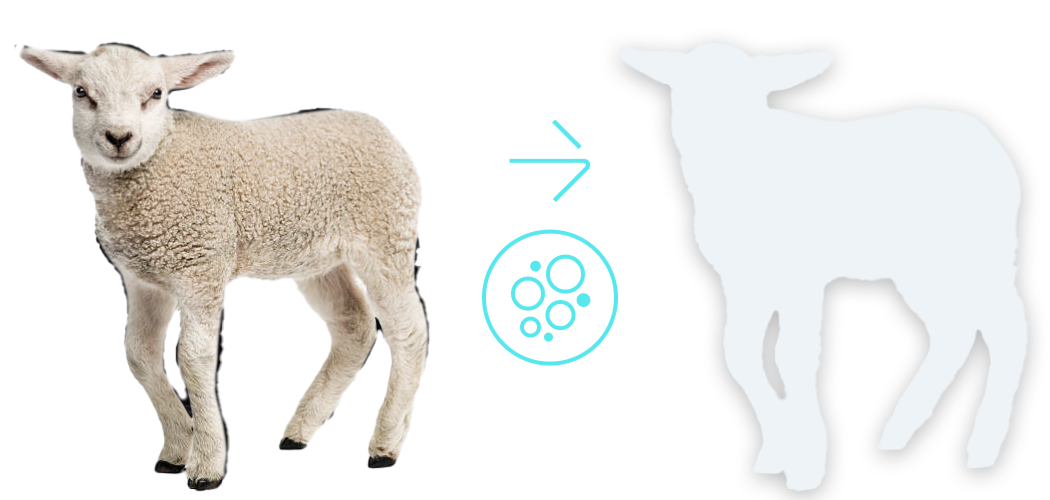
EXPERIENCE THROUGH EXPERIMENTS
Experiments in cloning led to the first cloned sheep. These experiments relied on assumptions regarding theenvironment, the integrity of cellular structures, and mechanisms of biological life.
ASSUMPTIONS
Generally, a person builds his or her knowledge base from experience and the lessons taught by parents and teachers. Similarly, society builds its knowledge base from experience and lessons. The experience that contributes to academic knowledge is gained through experiments, and the lessons are produced by the theoretical research of scholars.
Both experimental and theoretical work require assumptions. An assumption is a statement accepted as true without proof” [American Heritage Dictionary, 2nd College Edition, 1983). For experimental work, assumptions are utilized to develop the objectives, design, and conclusions of each investigation. For theoretical work, assumptions called axioms are utilized to logically deduce statements called theorems. Deductive reasoning guarantees that if the axioms are true, then the deduced theorems are true.
Problems with our knowledge base occur when fundamental assumptions are: a) too complex, b) false, c) con-tradictory, and/or d) ambiguous.
What assumptions are your beliefs built on? What assumptions would you choose as the foundation of society’s collective knowledge?
The modern paradigm includes assumptions about the Big Bang and evolution. Thus, someone might want to start with: “The world as we know it is the result of the Big Bang.”? This would be an inappropriate starting place because “the world as we know it” and “the Big Bang” are complex concepts. In particular, an understanding of the Big Bang requires some physics (mass, time, energy) and geometry (point, distance, space) and an explanation. An assumption that is too complex does not aid in providing an understanding of the big picture from its atomic parts. It can also lock in a bias that prevents discovery, as was the case with “the earth is flat” assumption.
Others might start with the clear, simple assumptions of Euclidean geometry. One of these axioms is: “A point and a distance define a circle.” This, however, is a false assumption for physical space since it implicitly assumes that spatial relationships are restricted to two dimensions. Dimension is a key concept for spatial relationships, and assuming some definite number may lock in an incorrect bias.
If someone chose: “Anything is possible” and “Space extends indefinitely in all directions” then the choice of assumptions would be contradictory. In a universal system where anything is possible, it is possible for a boundary to limit space in some direction. Thus, the axiom “space extends indefinitely in all directions” is a type of law that countermands the principle that anything is possible.
Given the difficulty of selecting good assumptions, some scholars try to avoid assumptions. Research requires assumptions, however, so avoiding them means that the assumptions are hidden and ambiguous. When assumptions are known and clear, they can be tested. When they are hidden and ambiguous, they cannot be tested, and they can lock in a bias that inhibits discovery.
Assumptions are tested by examining the results that have been deduced from the assumptions against experimental observations.
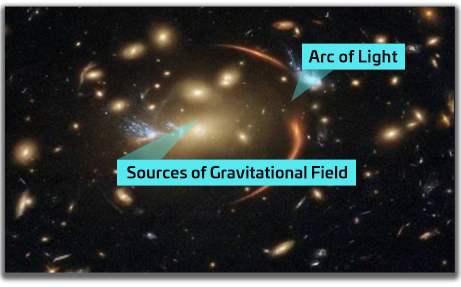
LIGHT BENDS!
A test of Einstein’s theoretical assumptions was made through seeing whether his prediciton about the behavior of light in agravitational field was true or not. The phenomenon of light travelling a curved path in a gravitational field was previously unknown before
For example, Einstein’s theory called General Relativity includes the assumption that light travels at a constant speed in a vacuum. A deduced result of the theory is that light bends in a gravitational field. Scientists performed an experiment when a known star was partially blocked by the sun to see if the light from the star shone straight or was bent in the gravitational field produced by the sun. The light bent. Their verifica- tion of Einstein’s prediction was a stunning validation of the theory’s assumptions.
On the other hand, the same theory predicts gravitation waves which have not been detected in experiments. This leads to the suspicion that Einstein’s assumptions are not entirely correct.
In summary, assumptions provide a critical basis of understanding. They need to be simple, true, consistent, clear, and explicit. Once assumptions are made explicit they can be tested for validity.
WORD SELECTION
In order to begin setting forth axiomatic assumptions, we need to use words that communicate effectively.
The only valid place to start in the world of communication is to use the words that we learn from experience independent of academic training in a given scientific discipline; otherwise, there would be circularity that undermines the effectiveness of defining scientific explanations. Let a common, informal language used by any large society apart for purposes other than math or science be called natural language.
Typically, the words taken from natural language for the purpose of making axioms are called primitives. Primi- tives are also used for the first formal definitions in a development.
A body of work in mathematical logic provides an example of a problematic choice of primitives.
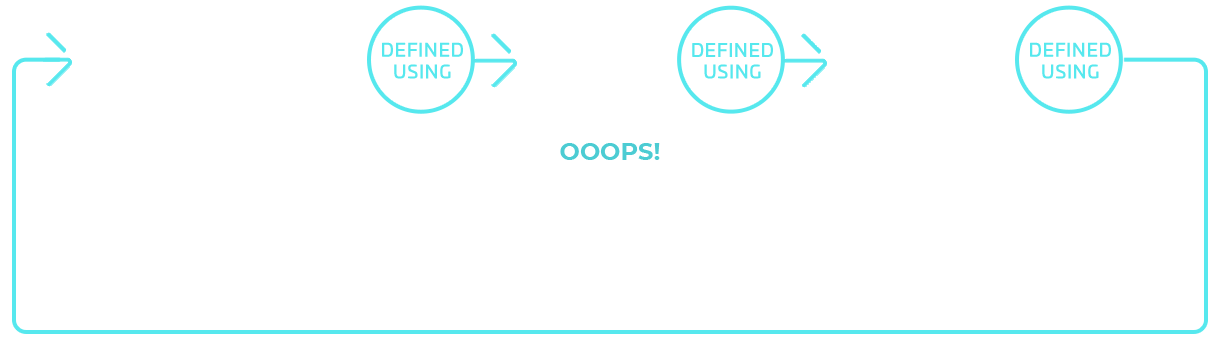
Mathematical logic sets forth an analytical tool to aid in the development of knowledge called the First-Order Predicate Calculus. The basic atoms of the Predicate Calculus are constant letters ai (e.g. a1, a2, a3, a4,…), variables xi (e.g. x1, x2, x3, x4,…), function letters f and predicate letters A where i and j refer to counting num- bers. The founders believed that the vocabulary of natural language included counting numbers; however, one of the ultimate goals was to better understand numbers and numeric relationships. Thus, the Predicate Calculus became a theoretical context for defining a formal theory of mathematics. Both formal Number Theory and Set Theory were constructed address this need. The end result is this. Numbers
areconcepts that gain their meaning from the context of mathematics. Mathematics is formally defined through Set Theory. Set Theory is defined using the Predicate Calculus. And the Predicate Calculus is defined using numbers which are defined by mathematics, which is defined by Set Theory, which is defined by the Predicate Calculus, which is defined by… Thus, the Predicate Calculus and formal Set Theory were defined through a form of circular reference. Definition through circular reference, however, does not work. It is as useful as saying “I define a googlethorpe to be a googlethorpe.” Consequently, a reliable foundation or basis for work- ing on knowledge requires a successful choice of elementary meanings [primitives] and assumptions. Consider again, however, the difference between personal knowledge and society’s knowledge. Can we work together on knowledge if everyone uses a different foundation?
IMPORTANCE OF STANDARDS
Knowledge can be seen as a large system that many different groups are working on. People who work on knowledge acquisition have experienced regular controversy over assumptions and language standards. This is an age-old problem as is evidenced by the Tower of Babel legend from ancient times. Working together as a group requires some attention to process since each individual in a group has his or her own idea of the best way to proceed. Typically, theories that advance explanations for society’s knowledge have been advanced in an ad hoc manner. How do we decide whose ideas and explanations are correct? Is it on the basis of which school the scholar received a degree from? Is it on the basis of the subjective opinions of experts, or because it fits with what we want to believe? In order for a group to be productive, everyone in the group must accept certain standards. Therefore, not only do primitives and axioms need to properly fulfill their role. they need to be identified and set as the standard. Let’s confront our differences to hash out a single foundation. Then, we can avoid many of the battles in individual disciplines that have marked the academic land- scape to date. Being explicit about key principles, assumptions, expectations, logic standards, language stan-
dards, etc. provides a big payoff in productivity. If we can agree to use a single foundation that supplies these standards, including standards for how to draw conclusions about knowledge, then nothing will stand in our way. We can pool our resources to discover all that is possible to know.

FINDING WAYS TO COMMUNICATE
Explanations of what is known should start with simple, elementary notions.
THE PROPOSAL FOR MOVING FORWARD
To summarize, the means to achieve reliable knowledge requires agreement among scholars to use a common foundation that provides a successful choice of elementary meanings and assumptions. Following is a draft proposal for a candidate to become this common foundation of academic scholarship. To the extent that we can find consensus for a final version of the standards that constitute this foundation, we will establish a common setting for working together on knowledge. As all development work takes place in some type of workspace such as a construction site or a factory, this body of work is called Place of Understanding. Alternate names are Place and P.
DOCUMENT MAP
- I. PreliminariesSome preliminary matters for getting started need to be addressed. A key distinction is made between noun meanings and verb meanings.
- II. DefinitionThis section includes basic assumptions and definitions related to the means to effect definitions.
- III. ConstructionThis section includes basic assumptions and definitions related to the means to effect definitions.
- IV. CommunicationThis section includes basic assumptions and definitions related to the means to effect communication.
A definition for true statements is set forth as well as principles of logic as they have been developed over the past centuries by many scholars. - V. Theories: Mental Construction SitesStandards for theory development are chosen to avoid inconsistency and ambiguity.
- VI. Some ResultsThis section uses axioms and results from the previous sections to deduce some results. For example, the following faculties of a fully-functioning mind are deduced: the presence of a Language Center and the presence of a Logic Center. The section concludes with a proof that if a theory complies with the standards of Place, then it is consistent.
- VII. ConclusionThe conclusion assesses whether the assumptions it proposes are consistent and sets forth expectations for moving forward.
FINDING A PLACE TO START
We have to start somewhere. Rather than debate the matter endlessly, please consider the axioms and defini- tions of Place of Understanding. The justification for taking these particular axioms and these particular initial definitions is provided by the delivery of a desirable mix of simplicity and utility in achieving the stated goals. For this type of development, if the axioms and definitions are accepted, then the results achieved through deductive reasoning are valid and acceptable.
Once scholars modify and finalize this protocol, the principles of knowledge acquisition formalized in Place of Understanding will provide a type of constitution. Scholars will have a stable system of government to provide order and justice for their work.
ASSUMPTIONS OF THE AUTHOR
I make the following assumptions in attempting this work:
Assumption MAE
Modern, American, written English can be used:
– as a known system of symbols and meanings1
– as a means to communicate
The words, meanings and language practices defined in this paper supersede or overrule existing definitions.
Note that these assumptions are basic assumptions of every academic paper written in American English.
Also, in the following pages:
"Def»" signals that a definition follows
"Syn>" signals that a rule of syntax follows
"iff" is an abbreviation for "if and only if"
GOALS
- I Explicitly, the objective of the following body of work is to provide:
- a) a universal frame of reference for understanding anything and b) a theoretical foundation for sound knowledge.
- Characteristics of success, as dis- cussed, include the following goals:
I. the identification of consistent axioms that we can agree on
II. axioms and definitions composed from natural language that is elemen-tary and independent from any specific discipline of science
III. the ability to provide an explanation, any expla- nation, that meets the expectations of the science commu-nity for clarity and consistency. - A universal frame of reference for understanding anything must be neutral to any specific discipline allowing experiments and analysis to determine which explanation is preferred.
- Please see if you can agree with the axioms pro- posed in the following sections. And please consid- er whether this system achieves these objectives and can provide a standard for working together on knowledge.
A Place of understanding
Prelimianries
HOW DO WE BEGIN?
We will begin by using everyday language. Readers need to have the vocab- ulary of an educated 13-year old and a good facility with grammar.
We will assume that people understand whether something is present or absent with respect to a particular setting (rather than whether it exists or not). Children understand what it means to be present or absent when attendance is taken at school in first grade. Thus, this approach should be elementary enough for a common frame of reference.
We will also assume that “meaning” satisfies Goal II since people understand “What does that mean?” or “What do you mean?
A CRITICAL SEPARATION
The study of American English has revealed a clear difference between the role of verbs and nouns. Consider what is common to noun meanings. Could we describe this abstraction of what is common to noun meanings as thingness?
Separate this from what is common to verb meanings.
We’ll use the following terms.
Def» Stuff signifies what is common to noun meanings.
Def» Force signifies what is common to verb meanings.
Observe that stuff, as it is defined here, includes physical things such as rocks, water and air as well as nonphysical noun things such as silence, fact, and liberty. Similarly, force includes the physical means to effect movement, and the means to effect sensory perception, as well as the nonphysical means to decide or the means to add numbers.
Now, here’s the tricky part. “Force” is a noun, but, it refers to the essence of a verb meaning. Due to the nature of language, we need a noun as the subject of a sentence, hence we employ the noun “force.” But try to hold on to the difference between verb meanings and noun meanings. The idea here is that when a verb is used in a sentence, it is referring to a meaning involving potency or the means to effect. And this potency is fundamentally different from stuff.
THE ABILITY TO BUILD OR CONSTRUCT
A goal of this work, as stated above, is the ability to provide any clear, rigorous explanation. In order to provide clear, rigorous explanations, we need to be able to build concepts, ideas, and relationships.

STUFF VS FORCE
Boat, water, sand, and a volleyball are types of stuff. To bump, to run, to stand, and to fall involve the potency of a force.
 Building A House
 Making Cookies
 Manufacturing A Product
-
CONSTRUCTION PROCESSES
A construction process is carried out in a setting that comes with capabilities and raw materials. Initial conditions followed by the execution of explicit steps produces the results that are present at any given stage of development.
If we want to make, fabricate, or construct something in general, what is involved? Consider construction processes such as building a house, making cookies or manufacturing a product. (See sidebar.) These processes require:
A. a construction site, such as:
– a plot of land
– a kitchen
– a factory floor
B. raw materials, such as:
– lumber, nails, screws, concrete, shingles
– butter, sugar, flour, eggs
– screws, wood, wire, silicon
C. capabilities provided by tools and workers, such as, the abilities to:
– hammer, cut, lift, measure, drill
– pour, measure, transfer, mix, heat, cool
– mold plastic, cut, hammer, screw, solder, move objects
D. the ability to build in successive steps or stages such that one stage is completed before the next one begins, such as:
– lay foundation, then frame ground-floor walls
– make batter, roll it out, then cut shapes
– mold casing, then attach circuit boards
E.an executive power which wills, controls, or governs the execution of capabilities at the site such as:
– the builder
– the cook
– factory workers
Are any major elements of a construc- tion process missing from this list? Could construction take place without a construction site or raw materials? Could something be constructed without capabilities or sequence, i.e. the ability to complete one step and then another? Wouldn’t every- thing stay the way it is initially without a decision-maker or first-cause to trigger the execution of the available capabilities? Note that in these exam- ples, the decision-maker also has a role in executing the available capabilities in a particular sequential order so that the desired results are produced.
Observe that the raw materials cited above are all initially supplied to their respective construction sites as portions of stuff which are separate from each other, and separate from the environment of the construction site. Individual boards, sticks of butter, sacks of sugar, rolled sheets of steel, and water from a pipe are examples of stuff that have bound- aries which were not determined by nature. A living tree has to be cut down and processed to make lumber; sugar cane has to be grown, harvested, processed and refined to produce sugar; and oil has to be found, pumped out from the ground and refined to produce gasoline and plastic pellets. These are definition processes.
We are concerned with making explanations about how the world works. Looking at construction processes in general reveals that the ability to make things requires that some defined materials be on hand. Therefore, consider the fundamentals of definition.
A Place of understanding
Definition
WHAT IS INVOLVED IN A DEFINITION PROCESS?
Let's look at some specific examples. Consider processes that define units of stuff such as making a roll of pennies, individuating sticks of butter and producing lumber. These processes require:

DEFINITION PROCESS
Going from forest to finished lumber is a definition process. The forest provides a source for the desired standard, wood. The wood must be separated from the forest and cut so that it matches the stan-dard for a 2×4.
Z. access to a source for that which is being defined, such as access to: – mix of coins from a piggy bank
– cow's milk
– a forest
Y. a standard which is unique to that which is being defined, such as: – the size and color of a penny
– fat, without carbohydrates or proteins
-wood, 2 inches by 4 inches by lengths over 5 feet
X. the means to separate that which matches the standard from that which does not match, such as:
– the means to put coins on a firm surface and move pennies apart from other coins
– ability to collect cream which naturally separates from milk and ability to churn it, since churning solidifies only the fat in cream
– ability to cut down trees, strip branches, transport the result, and cut wood in the desired dimensions
W. the means to maintain separation by containment within limits, such as:
– a paper wrapper enclosing a group of pennies
– paper wrapping around individual amounts of butter and the ability to keepthese units cool
– a confined area that the finished lumber can be stacked in so that it is protected from water and fire
Are any major elements of a definition process missing from this list? Could definition take place without access to a source or a standard? Could something be defined without the means to separate or maintain sep- aration? Perhaps a decision-maker is needed to determine the source, standard, and means of main-taining separation, but this will remain an open question.
Observe that a definition process which separates out a unique type of stuff is like the process of mining. When people mine for gold, they have a standard, a type of ore, which they are looking for. A mine provides a source for the ore. When something is found which matches the standard, it is separated from the other stuff around it, and it is stored in such a way that it will continue to remain separate.
For language, the mine is all possible meanings. The standard is supplied by a vocabulary definition. A unique word acts like a container to help separate the meaning and store it in such a way that it will continue to remain separate.
The above examples refer to differentiating units of stuff that have spatial boundaries. We can also define physical things that do not have definite spatial boundaries. For instance, we can distinguish between what is wind and what is not wind in a physical setting. Not-wind includes sunlight, trees, clouds, etc. We can then use key features of this difference between wind and not-wind to develop a standard for what wind is. Similarly, we can define non-physical noun meanings such as joy, liberty, marriage, and protocol.
Above we considered the process of defining units of stuff. Now consider the definition of forces such as forces provided by a person with a hammer, a kitchen blender, and the sun. Definition of a force requires:
Z. access to a source of activity and change in which the force being defined is active, such as:
– a work area in which a person actively works with a hammer
– a kitchen in which a person is using a blender
– physical activity on Earth's surface
Y. a standard which is unique to the force being defined, such as a direction of succession:
-from: boards and nail, to: board joined to board by the nail
– from: some foodstuff with a given structure, to: a homogeneous mix
– from: darkness to: light
X. the means to separate that which matches the standard from that which does not match, which is given by the means to separate: a) initial conditions before force is active, then b) what the force effects as an output, and the means to distinguish (a) then (b).
W. the means to maintain separation, that is the means to maintain a consistent direction of succession for this particular force versus all possible change.
Thus, a definition process, whether it is used to define some stuff or a force, includes:
- a source that provides access to the desired something
- a standard
- the means to separate the desired something that matches the standard from everything else
- the means to maintain separation.

FAILURE TO MAINTAIN SEPARATION
The means to maintain separation between the boards and everything else failed due to a railway accident. Some boards still match the desired standard, but some do not. picture by Chris Carlson/AP
ORDER VERSUS CHAOS
We’ve looked at some examples of successful definition processes. And we have observed some aspects that are common between these examples. Another observation is that these definition processes assume the ability to maintain order.
The ability to separate involves patternmatching, and the ability to maintain separation involves making restrictions; these in turn depend on a consistent state of order. The best way to get at a deeper understanding is to look at the opposite of order.
Imagine a place where anything could happen…. a place where different people could occupy the same location at the same time, things could spontaneously appear and disappear, and a grown plant could sequential- ly precede the sprouted seed it comes from. Any attempt to maintain separation between different things or actions would not be successful.
In such a scenario, there are no reliable boundaries. Everything gets mixed up.
In such a place, we can only grab on to the whole setting, i.e. everything, or nothing. There are no consistently distinguishable parts, elements or activity.
VOCABULARY AND ASSUMPTIONS
Following are some carefully chosen assumptions and vocabulary to govern the definition work we do together.
Note: In order to convey these prin- ciples and standards, the word “something will be used. “Some-thing” is a pronoun. It is used to refer to any meaning, it could be a noun meaning or a verb meaning.
The following definitions are in the spirit of common usage (natural language), while aiming for more precision in service of our goals.
Def> Rule refers to the means to effect a limit or restriction.
Def Chaos refers to a setting in which all rules, limits and restrictions are absent.
Part… whole distinction:
Def> Part refers to that which is not all and not none.
Def> Whole refers to that which is all.
Separation:
Def» Something is separate from something else iff no part of something is a part of something else.
Def> Joined refers to not separate.
The ability to distinguish between what something is and what it is not is an ability that shows up early in life. Consider that a baby can identify his or her mother versus everything else. A baby clearly knows his or her Mama versus everything that is not the-Mama.
The clarity we want for science requires that a definition separate the something being defined from everything else – no ambiguous gray area.
In working together on knowledge, definitions must enable us to distinguish between what something is and what it is not-to distinguish when something matches the standard and when it does not. If this is not the case, then the noun meaning, verb meaning sentence meaning, or idea is like a chaotic setting, it is equivalent to everything or nothing. This is formally stated in the following axiom.
CANNOT SEE/DETERMINE BOUNDARIES
Where does one thing begin and another end? The identity of distinct things is ambiguous.
smog-covered cityscape
NOT-NOTHING ASSUMPTION
Something is not everything or nothing if and only if something is separate from not-something.
This assumption claims that if what something-is joins with what it is not, then how it differs from everything or nothing is ambiguous.
“Something” is a pronoun that refers very generally to any possibility. Let X be a symbol to represent “some- thing,” then this axiom can be expressed: X is not [everything or nothing] iff X is separate from not-X. For example, the color black is separate from all that is not black. If black is not separate from all that is not black, then sometimes white could be black, joy could be black, teaching could be black, or music could be black.
A unique verb meaning also needs a distinct identity. For example, we’d can make a clear distinction so that the force to mix concrete’ is separate from ‘not to mix concrete.
FORCE EXAMPLE
The standard for to mix is given by a direction from: separate stuff in the bowl, to: stuff joined together uniformly. To pour might be defined by the direc- tion from: liquid in a container, to: liquid being transfered out of the container in a steady stream. We can distinguish the difference between to mix and to pour.
FORCE ASSUMPTION
The definition standard for a force provides the means to determine a direction: from what it acts on, to what it effects.
This assumption claims that the means of identifying a unique a force is given by the direction associated with change from one state to another state.
For example, (see sidebar) the defining-limit of the force provided by a mixer is from: separate stuff in the bowl, to: stuff joined together uniformly. Activity or change associated with this direction (to mix) can be distinguished from other types of activity and change (not-to-mix).
STUFF EXAMPLE
The standard for the stuff that we call the sun should provide the means to determine the presence of the sun versus its absence. The standard should provide the means to distinguish between the sun and all that is not the sun.
STUFF ASSUMPTION
The definition standard for some stuff provides the means to deter- mine if it is present or absent.
This assumption claims that the standard for some stuff provides the means to determine the difference between it’s presence and it’s absence.
For example, consider the presence of the sun versus its absence. Does the identity of the sun include the heat we feel lying on sand at the beach? The canonical academic definition of “sun” should provide a unique, authoritative means to distinguish between the sun and all that is not the sun.
Similarly, the presence of joy (a noun meaning) is different from the absence of joy and the separation between the presence and absence of joy provides the basis for a definition standard.
With respect to personal knowledge, an individual supplies the authority for determining definition standards.
With respect to the knowledge base of society, a community of respected scholars supplies the authority for determining definition standards.
Maintaning seprations
Def> The domain of a force refers to all that can be affected or used by the force.
For example, when a person drives faster than the speed limit, then he or she violates one or more traffic rules. If the ability to maintain separation with respect to a definition process fails, then the corresponding defini- tion rule is violated.
Def> The scope of a force refers to all that can be effected by the force.
For example, when a person drives faster than the speed limit, then he or she violates one or more traffic rules. If the ability to maintain separation with respect to a definition process fails, then the corresponding defini- tion rule is violated.
Definition standards related to a force:
Def> The domain of a force refers to all that can be affected or used by the force.
Def> The scope of a force refers to all that can be effected by the force.
Note that a rule is a force, since it is a means to effect. A rule is a force whose definition standard is from: ran- domness, to: consistent order.
Def>» Something requires something else iff something else must be present before the something can either be present or effect.
Def> Something satisfies a requirement iff the presence of something supplies that which is required, i.e. that which must be present.
Def> Something complies with a force iff a) the something is contained in the domain of the force and is affected so that it produces the effect that satisfies the force’s standard direc- tion, or b) it is not contained in the domain of the force.
For example, if a father sets a rule that his child should be home in time for dinner, then the child complies with the rule if he or she is consistently home in time for dinner. The pet turtle that lives next door also complies with this rule because it is not something affected by the rule. It is not in the domain of the rule.
Cause…effect:
Def> Cause refers to that which acti- vates or determines that some force effects.
Def> Effect refers to the result created, produced or determined by stuff and/or forces in a given setting..
Def> A feature refers to an effect determined by the presence of stuff in a given setting, and its own presence is referred to using an adjective.
Def> A quality refers to an effect determined by the potency of a force in action from what it affects or uses to what it effects within a given setting, and its own presence is referred to by an adverb.
Note that a cause is not associated with the identity of a force, i.e. a force’s “from” is not that which acti- vates it. A force could be activated by multiple different agents. Once a force is activated, it uses or affects some- thing (its “from”) and then it effects something (its “to”). Different observers can disagree about what causes the activation of a force.
Additional Terms:
Def>Somethings are multiple if and only if they are separate and match the same standard.
Def>Single refers to not multiple.
Def> Something is dependent on some-thing else iff something requires: a) the something else or b) a result which requires the something else.
Def> Independent from refers to not dependent on.
Def> Something I something else refers to the direction from some- thing to something else.
Def> Something II something else refers to the boundary between some-thing and something else.
Def> A defining-limit [d-limit] refers to the unique, authoritative separa- tion between something and not- something.
SUMMARY REGARDING DEFINITION
In summary, the activity of defining is about setting forth rules.
Each definition rule provides a standard that enables people to distinguish between what matches the standard and what does not match the standard. If the rule fails to do this, then the thing being defined is intel- lectually equivalent to everything or nothing.
Our goal for consistency and clarity requires that the system of meanings we employ have the property that each meaning is separate from its negation-either meaning A is present or it is not-no ambiguity.
A force is identified by a standard that enables people to determine a direction: from what it acts on, to the result it effects. Some stuff is identified and separated from everything else by a standard that enables people to distinguish between its presence and its absence.